

When you visit a supermarket or grocery store, you will usually find a variety of options for pretty much any product. They don’t necessarily compete with each other, though. Some will be cheaper, some will be higher quality, and some will be presented in different colours or shapes -and usually there will be clients willing to purchase all of those varieties.
When you check behind the scenes, each one of those companies had a reason (right or otherwise) to produce and distribute their goods in that specific way.
It’s not unusual for people to see an automatic link between an organization’s strategy and its marketing efforts, for instance, but one of the most overlooked connections in business management is between operations and strategic planning. The way an organization operates both influences and is heavily influenced by what the leadership team defines as that organization’s identity and goals -if a company wants to deliver the best quality goods in its industry, its operations (processes, machinery, people, systems, etc.) need to reflect that decision. But when restrictions are in place (usually, but not limited to, capital), the strategic definitions need to be adjusted to the organization’s actual landscape.
This means that it’s usually not advisable to promise a quick turnaround on items if your operations can’t deliver faster than your competitors, or to sell your product at a price that leaves you with no margin to cover your fixed costs. If this is your scenario, you either improve your operations or change your strategy -or, of course, just live with leaving your customers or bank account constantly unhappy, which is strongly not recommended.
In the 1990s, one of the most recognized business authors of all time, the English professor Nigel Slack, alongside his co-authors Stuart Chambers and Robert Johnson, created the concept of ‘Operational Performance Objectives‘. In its original form, this framework defines five key dimensions that organizations should use to plan, measure, and improve their operations.
These dimensions (a.k.a. core objectives) serve as a translation layer between an organization’s strategic planning and its operations. By defining what’s desired and expected in quality, speed, dependability, flexibility, and cost (and comparing this desired state with the current scenario), the management team can decide how operations should be improved or how the organizational identity should be reshaped.
Quality “stands for doing things right,” speed stands for “doing things fast,” dependability stands for “doing things on time,” flexibility stands for “doing things in different ways,” and cost stands for “doing things at the right cost.”
If you’re reading this concept for the first time, note that the brief notes on each dimension do not use absolute terms such as “the best,” “the fastest,” or “the cheapest.” It’s about what the organization wants to deliver -and delivering it!
The usual way to understand these dimensions is by looking at them represented in a radar chart, like this:
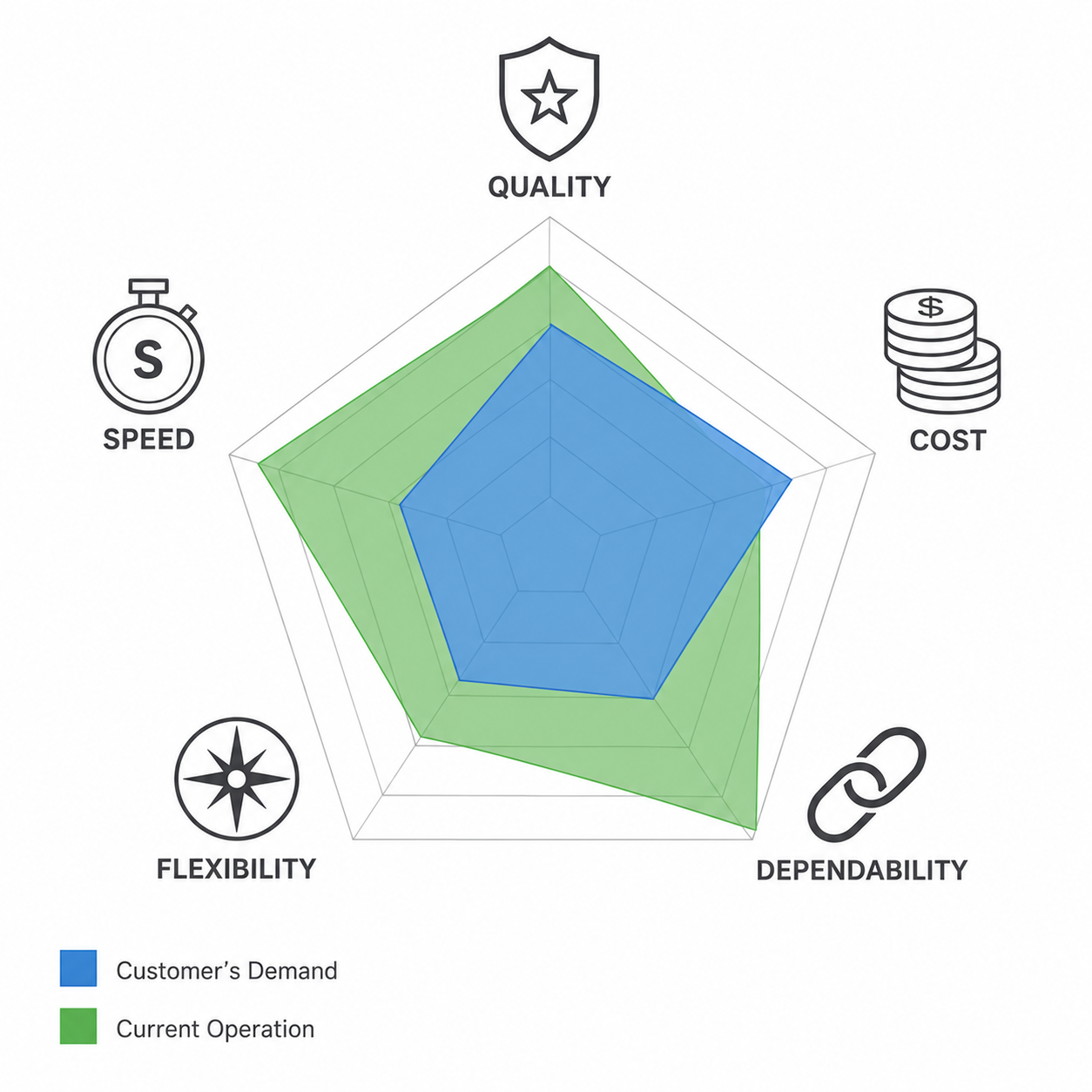
As exemplified above, the radar chart can help analyze both the clients’ requirements and the organization’s current state, and then create an action plan to realign operations with what’s actually required. In a quick thought experiment using the example above, this organization is clearly spending too much by maintaining a structure that delivers a faster, higher-quality product and more options than the clientele expects or requires, while charging more than they’re willing to pay.
From that scenario, the organization might decide to either find another customer segment that might be looking for what they offer and willing to pay more for that, or adapt -imagining this is a factory, they’d likely be able to reduce production lines, get rid of some of the machinery, use cheaper supplies, or even use the spare resources to create a new brand or product segment.
It’s important to highlight that the quality of this sort of analysis is highly dependent on the quality of the information that’s input -by adding “guesses,” that’s what you will get in return. And just as we discussed in the factory example above, any type of organization can benefit from understanding its case to make informed decisions. Additionally, this same tool can be used to compare a company’s scenario to their competitors and the distinct alternatives its clients have for the same service or good.
Often neglected, a structured, proper operational analysis is vital to the success of any organization, as it can pinpoint investment needs, optimize resources, and ensure that deliveries align with what your customers really want and with business needs.
In later publications, Slack added another section to this framework: Responsible Operations. While this is not an additional dimension, it can be seen as a “set of lenses” you use to examine your operations alongside the actual objectives (the five listed above). Beyond being a demand from many distinct customer segments, the business world as a whole is shifting to prioritize sustainable and responsible organizations over the opposite.
If you own or work for a small business, resource optimization is likely one of the topics you discuss or strategize about most, and tools/frameworks such as the Operational Performance Objectives can greatly help your company run better, leaner, and more efficiently.
Analyze, understand, and make informed decisions.
Do you want to learn how your business in Oxford County, or anywhere else in Ontario, can achieve better, more streamlined operations? Talk to us!