
Category: Blog Post

  • Failing Up

    Failing Up

    Any project, business, or action might fail. This is true regardless of how prepared you are, how skilled the people executing that idea are, or how hot the market for certain goods or services might be. Failing seems bad, and the connotation of that word drives us to avoid it at any cost.

    Failure, however, is one of the things we will certainly face during our lifetime -all of us! From the small failures of dying during a boss fight in a video game or getting rejected when asking for a date, until the big ones that cost us a lot of money and time.

    Despite the fact that it’s inevitable, we shouldn’t leave the success of our project or actions to pure luck -and that’s when bracing and understanding failures can help us. When we simply avoid failure, we might be losing the opportunity to learn from it; therefore, the chance to not fail again.

    Embracing failure is not only important, but EXTREMELY valuable for both human beings and organizations: we learn to walk as babies after falling down many times, we learn how to multiply two numbers after getting the wrong answer a number of times, we learn how to publish an app after finding and correcting a thousand bugs, and we learn how execute projects after failing to plan and deliver several others.

    The cognitive psychologist Gary Klein was interviewed about the theme and introduced the concept of a “pre-mortem” exercise, which involves analyzing any given project before “the patient dies.” He invites teams and companies to consider they are in the future and that the project failed: why did the project fail, and what could have been done to prevent it?

    As discussed in a different episode of the Freakonomics podcast, people tend to be optimistic about projects that are starting, which is also why New Year’s resolutions will usually boost people’s morale. Being optimistic, team members will forecast that the project will be a success and might disregard risks, even those occurring in front of them.

    That’s why Klein’s exercise drives people to think in the opposite direction: our project went wrong -what now?

    Admitting mistakes -besides, of course, working to fix them- is extremely healthy for any organization and the first step towards improvement. Truthful diagnostics always start by listing mistakes and issues, and companies seeking improvement must be highly self-critical and admit errors.

    What are clients saying? Could they be happier?

    Why did our last projects fail (or, at least, derail)?

    Why did we lose some of our better team members?

    Could we be selling more?

    Growth comes only from tackling the right areas, and an accurate diagnosis is vital to unlocking the potential of any organization.

    Do you want to map out and fix issues in your business in Oxford County, or any other part of Southern Ontario? Talk to us!

  • Project Management Methodologies

    As we discussed here, managing innovation and new projects properly is extremely important for companies of all sizes and industries, although frequently overlooked -when looked at at all.

    However, to do it properly, companies must have an appropriate methodology in place -if each team member uses a different tool, things won’t connect, and chaos will almost certainly ensue. There are a few of these methodologies widely spread throughout the market and used by many companies. The Project Management Institute (PMI) and its associates have been working on the PMBOK and have published seven editions of it. That is a collection of good practices that span from the initial project negotiation to the review of all its deliveries.

    The PMBOK, despite bringing this list of suggestions on how to manage the diverse steps of a project, should be understood. It’s not a full, one-size-fits-all methodology. As a collection of good practices, companies and managers should select the ones that fit their reality and needs, rather than following everything blindly. The entirety of the PMBOK can be rather bureaucratic, making it time- and capital-consuming.

    Not long ago, various agile methodologies were developed by different teams and organizations. The term “agile” is associated with the recent technological behemoths from Silicon Valley, and it was adopted because the PMBOK, as mentioned above, can be perceived as bureaucratic, slow, and overly complex with unnecessary steps and controls.

    There’s gotta be a better way!

    And that thought led to the creation of the Scrum, Kanban, and Lean project management methodologies. However, not all of the steps that those methodologies bring should also be blindly followed. Physical, personal, or time needs/constraints might not make any of those fully compatible with an organization’s reality.

    So, even though those modern tools were created for the newer times, they suffer from the same issues as the PMBOK: it’s not for everyone. And if companies need something in place to help them manage their projects, but no single tool might fully meet their needs, what should they do? Create your own!

    It’s essential to clarify what we mean by “create your own,” as it’s not advisable for each company to reinvent the wheel, especially since existing methodologies are constantly being developed and tested, with regular tweaks and improvements. Useful management methodologies are something hard to put together, and will very likely end up in another tool that will not fit all cases, but if you use parts of what already works, you can end up with something tailored and useful.

    Maybe, then, the risk assessment tool that the PMBOK brings can be the right fit for you, but the project kick-off process described in the SCRUM methodology suits your company’s case more. By piecing together all the different tools and steps that make sense for you, the organization will find a tool -YOUR tool- that can become the single source of truth and standardize project management efforts, and just like any other methodology, it must be tested, verified, iterated, corrected, and retested. Companies might even use parts of modern and traditional methodologies, but ensure that the inputs and outputs for the diverse stages align and match.

    There’s one catch in all of that, though. This “Frankstein” methodology needs a tool. Usually, apps such as Trello, ClickUp, or Asana can do the trick and help in most cases, but -again- not all. Just as the different parts and their connections need to be tested, the use of such a platform also needs to be tested and validated, including functionalities, user interface, reports, and automation possibilities. Most of those apps can also be configured and set up in different ways, which will require tests and someone who knows how to use the software effectively.

    In summary, companies can develop their own methodologies and tailor them to their specific needs, but this process must be done thoughtfully and appropriately, without disrupting operations further.

    Plan, test, iterate, correct, and implement.

    Do you want to learn how an appropriate project management methodology can help your business in Oxford County, or any other part of Southern Ontario? Talk to us!

  • Quality Management Systems

    While I could bet that almost everyone has heard about ISO systems (the most famous being ISO 9001), I would certainly win a second bet that those same people do not know how these systems can benefit their companies beyond the certification -and they can!

    Many businesses operate in fields that require specific certifications, such as ISO 27001 for information security or ISO 14001 for environmental management. Besides meeting legal (or market) requirements, this is an excellent opportunity for those organizations to rethink how they operate, how they control their processes, and how standardized they are. As I described here, many companies lack the opportunity, capacity, or organization to analyze their flows and their work.

    One of the main benefits that is shared when people discuss meditation is that you can use the meditation moment to think inwards and understand yourself. Maybe there are thoughts you’re having that should not be there. Perhaps you’re feeling pain somewhere that you had never noticed. Until you take the moment to pause and think about yourself, you might never notice those, and this is what the implementation of a quality management system can become: the meditation time of an organization.

    When an organization decides to run such a project, the first thing to do is understand its goal -why do we want to implement a quality management system? Regulatory demand? Market differentiation? An arbitrary executive decision? The answer to this question greatly influences how the project should be planned and executed, besides the overall motivation of the people involved. What’s your reason?

    Second, it’s essential to understand what that system requires, especially when a certification is the goal at the end of the process. Does it need new process manuals? Specific treatment of byproducts? Minimum standards for client service? How frequent are the mandatory reviews? These pieces of information will hugely influence the planning of the resources and the evaluation of the viability of that new project. The end goal and what’s expected will also play a massive role in the tasks and assignments.

    Once the goal and the requirements are correctly listed, the organization’s current situation must be assessed, and this is when the meditation comparison can be applied -what habits does the team present that are not desirable? What are our pain points? In which parts are we not so efficient (or not efficient at all)? Where is the organization presenting the highest number of mistakes and non-conformities? Also, which solutions were tried in the past, and which worked and which didn’t? This “organizational meditation” is crucial at any moment of a business’s lifespan, but is vital in quality management systems’ implementation projects.

    And when both the system’s requirements and the business’s current situation are known, the team involved has mapped the starting point and the project’s end goal, making the plan and execution much more accurate. Then, the workflows will be reviewed, created, and/or documented, the control processes will be defined, and the analyzed metrics should be listed alongside their collection methods and acceptable ranges. It’s not uncommon, especially when companies hire external consulting professionals, that procedures and processes designed for other organizations are also used on that project. It’s imperative, however, that the team uses a methodology and workflows that are tailored specifically to that organization. Existing team members might have practical ideas on how to improve or standardize processes, and that’s extremely valuable to any company -listen to them!

    The training portion should receive special attention, too, as it represents bringing the defined methodology to life and will also play a significant role in addressing employees’ concerns. Take the time to understand their perspective, explain the importance of the new standards, and how everybody’s help is needed. Lastly, the implementation team should ensure the documented processes are being executed as planned and that all involved teams meet expectations. This follow-up process needs to be maintained and enforced from that moment on, and should be the main asset for that organization to keep the new system in place.

    Besides that initial cycle, each periodic review of the system standards is a new opportunity to check what’s being done and what can be improved. Just like meditation is a continuous exercise for those who have adopted it, implementing a quality management system is an excellent opportunity to have frequent opportunities to rethink and improve an organization’s operations.

    Do you want to learn how to implement a quality management system and help your business in Oxford County, or any other part of Southern Ontario? Talk to us!

  • TRIZ

    TRIZ, also known as the Theory of Inventive Problem Solving (derived from the Russian “Teoriya Resheniya Izobretatelskikh Zadach”), is an innovation framework developed by the Russian engineer Genrich S. Altshuller while he was working at a patent office in Azerbaijan. Curious about the origin of all the innovation projects he saw every day, he started researching those sources around 1946 and published the initial paper about the tool in 1956.

    From his research, he was able to map and identify the innovation framework that all of those inventors used to create their projects. The patent requests were divided into five categories:

    1. Routine/Apparent Solutions – Innovative projects that use an existing item and improve it with a known/familiar part, like upgrading a piece of machinery with an off-the-shelf component. Altshuller found that around 35% of the projects he analyzed fell into this category.
    2. Minor Improvements/Minor Inventions – Those projects that use an existing improvement as inspiration to modify an item, such as observing that a competitor implemented an upgrade to their product and creating a method to implement a similar upgrade to yours. Around 42% of the projects were found in this level of innovation.
    3. Major Improvements/Major Inventions – Similar to the previous level, but instead of drawing inspiration from within the same industry, bringing an innovation seen in a different market, such as applying a military solution to the residential energy generation industry. Roughly, 19% of the projects were classified as such.
    4. New Generation/Fundamental Inventions – Applying scientific principles or discoveries to come up with the solution to a problem or the innovation in question. Usually, these studies are initiated in University laboratories and account for 4% of the analyzed projects.
    5. Discovery/World-Changing Solutions – As the name suggests, these are groundbreaking discoveries that have the potential to change things on their own, like electricity distribution or the internet. They are almost exclusively (if not entirely) funded by governments and other public agencies, and represent only around 0.3% of the innovation projects studied.

    The Altshuller Institute continued its research, and the numbers consistently matched the engineer’s initial findings. Similar to what Altshuller concluded, we can see, by observing levels 1, 2, and 3, that the vast majority of innovative projects come from solutions, products, and methodologies already known and available on the market -roughly 96% of those.

    And this fact was the main breakthrough from his research. By observing the world, one might be able to come up with solutions that would solve and/or improve 96% of the cases they face. And this means that almost every problem companies and leaders have is already solved somewhere else – they just need to do a little more research. The article below is one of my favourite examples of this principle:

    Found at https://www.smithsonianmag.com/smart-news/scientists-dressed-horses-zebras-determine-purpose-stripes-180971540/

    Nature gave scientists and farmers a solution for the horses being bitten by flies -they just had to observe. On a side note, there’s a whole subject that studies the nature and how its concepts can solve the many challenges we face as human beings across diverse disciplines; it’s called Biomimicry.

    From that observation, Altshuller developed what came to be known as the TRIZ framework. The tool helps the user identify a specific problem (which is derived from a contradiction), transform it into a general problem, identify a general solution for it, and then design a specific solution. The core of the flow (general problem -> general solution) is precisely what matches the idea of observing the world around us and understanding the solutions in place.

    The detailed flow is known as the Algorithm of Inventive Problem Solving (or ARIZ, from the RUSSIAN), and it brings:

    Analyzing the System >> Analyzing the Resources >> Define the Ideal Final Result (IFR) and Formulate the Contradiction >> Separate the Contradiction >> Apply the Effects, Standards, and Principles Knowledge Base >> Change the Initial Theoretical State >> Review the Solution >> Re-Iterate and Improve >> Review and Post-Mortem Analysis

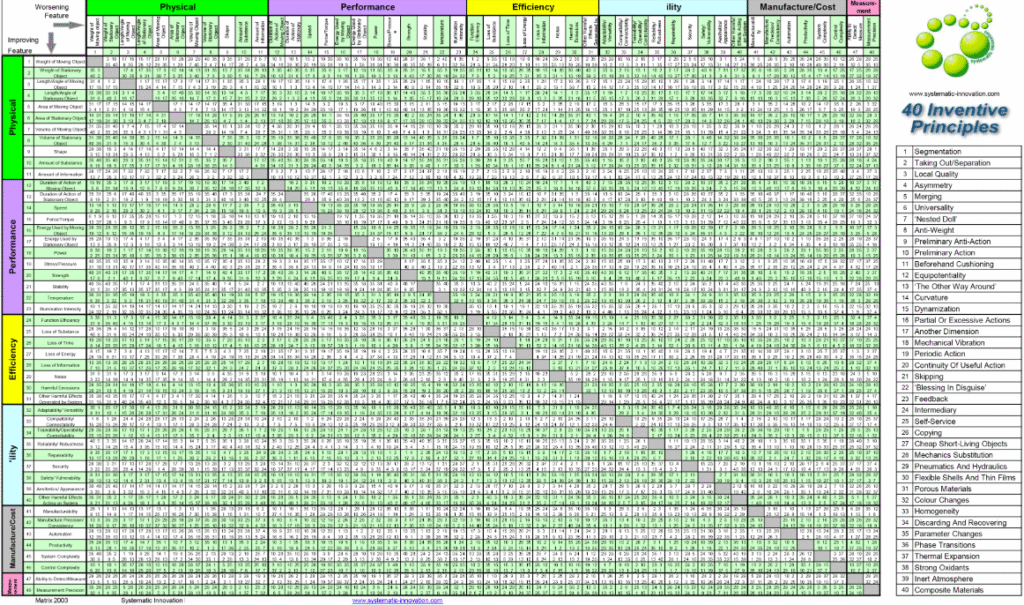
    To be able to apply the ARIZ and get the benefits of the TRIZ framework, you will need to utilize the Principles’ Matrix, as shown below:

    Found at https://the-trizjournal.com/contradiction-matrix/

    Those principles were all collected from the research Altshuller conducted and represent what was found in the analyzed innovation projects. As you might notice, those principles are more suited to “heavy” engineering, such as factory structures and mechanical engineering. That’s because, of course, those were the topics mostly studied back then. It doesn’t stop managers and leaders from still using it nowadays, or adapting it to different uses, such as marketing or Management.

    Now, even when you use TRIZ in its original form, the framework is still very useful because it prompts the user to consider different angles and perspectives, which will almost inevitably lead to insights and, often, the resolution of the problem. That is the main benefit of using an innovation methodology such as TRIZ, or some of its “relatives” like Nine Windows.

    Having these tools, frameworks, and methodologies at hand can enable any team or company to break the “lack of creativity” blockage, solve problems, and bring innovative solutions to any market and scenario. Maybe it’s time to structure your organization’s innovation efforts (regardless of whether inside the research & development department or not) and increase your impact in your market -have you ever tried that?

    Do you want to learn how to implement innovation processes and help your business in Oxford County, or any other part of Southern Ontario? Talk to us

  • Organizational Ambidexterity

    In your personal life, there are moments when you might lose focus because your eyes are on something else. We don’t have the hands or parallel-processing power to have much on your plates. That’s why many specialists argue that people can’t really “multi-task.” And, yes, using a cell phone will impair your driving ability.


    When we talk about organizations, something similar happens -especially when we talk about small or medium-sized ones. At present, any organization needs to service its clients and fulfill all its promises; this is the basic requirement for keeping any balance sheet balanced. However, another thing that companies need to keep an eye on is the future. Changes need to be made, processes need to be improved and/or redesigned, people need to be hired, new products (services or goods) need to be planned, etc. How can I aim at the future when all my resources are allocated to deliver our current promises and make the company survive?

    Just like humans, organizations can’t focus on too many things simultaneously. Resources are limited, and I can’t compromise my survival today by thinking about a future that may never come, right? Similarly, how can I anticipate tendencies or be ready to overcome competition in the future if I’m not planning for that?

    This problem is extremely common in organizations of all sizes, even when those companies are not paying attention. At any moment, companies usually pay attention to one of those two focuses -the present or the future- while the other is relegated to when “something happens.” And if lines such as “Ah, crap, that client’s delivery will be late” or “Hm, we were not anticipating that turn in the market” are common occurrences in your organization, I might be talking about you.

    A company’s ability to pay due attention (and deliver) in the present while also considering and preparing for the future is known as “organizational ambidexterity,” and, just like any ability, it can be developed.

    Most companies’ leadership teams will be primarily busy firefighting or fixing issues and putting order into chaos. This will take most of their time and prevent them from focusing on other activities, such as watching market tendencies, developing team members, or reviewing workflows. Therefore, those companies are underprepared (or unprepared at all) once the future arrives, and the infinite cycle of “solving today’s issues and focusing on the future later” never ends. Those organizations are used to that.

    Parallely, companies that spend their time and resources thinking about new products, new markets, and what might come might end up losing track of the present, not producing or delivering what needs to be delivered now. This will make them lose clients or never have them to begin with. Thinking about these situations, it’s clearly imperative that those organizations’ leaders need to adequate how they manage and run their businesses in order to survive and thrive.


    Acquiring “organizational ambidexterity,” despite not being impossible, is a project that demands attention, energy, and intention. This process will usually start with a complete overhaul of the current operations: Which team members are allocated to which task? How is each workflow designed, and are they being executed as expected? What are the current issues that clients and employees are facing? What are our current performance metrics, and how are we doing in them? And, finally, are we delivering what our strategic plans describe (by the way, do we have strategic planning?)?


    By digging deep into the organization’s current state, enough input should be available to list -and later execute- what needs to be fixed for the present to run satisfactorily. If properly implemented, these fixes should give an appropriate pattern for the current operations, let the manager focus solely on odd cases that escape the planned flows, and free up time for the management team to consider future plans and improvements.


    Now, thinking about the future can and should not be a random exercise of imagining how the next months or years can be. Similarly to how we seek to bring order to the organization’s present, planning what’s to come needs a pattern and order. Specific research and development processes must be in place, information sources must be listed, and a specific strategic plan should be defined. Additionally, are we using specific tools? What resources are available to change/innovate? Who will be responsible for each step or stage? Do we want to optimize and change what we currently have, or do we aim to create new things?

    Little will be accomplished if we just transfer the current chaos to the tasks related to the future steps.

    So, in summary, the organization needs to seek standards. The present should follow guides, and the future must be pursued orderly. This doesn’t mean that things should be rigid, mainly because that would likely kill innovation initiatives, but even creativity can be aided by some well-built patterns. Plenty of innovation tools can help with creation and innovation in any organization while keeping the current workflows organized.


    Making an organization ambidextrous is not an easy task, but one of the most reliable ways to make it “future-proof.”

    Do you want to learn how to optimize your business in Oxford County, or any other part of Southern Ontario? Talk to us!