TRIZ, also known as the Theory of Inventive Problem Solving (derived from the Russian “Teoriya Resheniya Izobretatelskikh Zadach”), is an innovation framework developed by the Russian engineer Genrich S. Altshuller while he was working at a patent office in Azerbaijan. Curious about the origin of all the innovation projects he saw every day, he started researching those sources around 1946 and published the initial paper about the tool in 1956.
From his research, he was able to map and identify the innovation framework that all of those inventors used to create their projects. The patent requests were divided into five categories:
- Routine/Apparent Solutions – Innovative projects that use an existing item and improve it with a known/familiar part, like upgrading a piece of machinery with an off-the-shelf component. Altshuller found that around 35% of the projects he analyzed fell into this category.
- Minor Improvements/Minor Inventions – Those projects that use an existing improvement as inspiration to modify an item, such as observing that a competitor implemented an upgrade to their product and creating a method to implement a similar upgrade to yours. Around 42% of the projects were found in this level of innovation.
- Major Improvements/Major Inventions – Similar to the previous level, but instead of drawing inspiration from within the same industry, bringing an innovation seen in a different market, such as applying a military solution to the residential energy generation industry. Roughly, 19% of the projects were classified as such.
- New Generation/Fundamental Inventions – Applying scientific principles or discoveries to come up with the solution to a problem or the innovation in question. Usually, these studies are initiated in University laboratories and account for 4% of the analyzed projects.
- Discovery/World-Changing Solutions – As the name suggests, these are groundbreaking discoveries that have the potential to change things on their own, like electricity distribution or the internet. They are almost exclusively (if not entirely) funded by governments and other public agencies, and represent only around 0.3% of the innovation projects studied.
The Altshuller Institute continued its research, and the numbers consistently matched the engineer’s initial findings. Similar to what Altshuller concluded, we can see, by observing levels 1, 2, and 3, that the vast majority of innovative projects come from solutions, products, and methodologies already known and available on the market -roughly 96% of those.
And this fact was the main breakthrough from his research. By observing the world, one might be able to come up with solutions that would solve and/or improve 96% of the cases they face. And this means that almost every problem companies and leaders have is already solved somewhere else – they just need to do a little more research. The article below is one of my favourite examples of this principle:

Nature gave scientists and farmers a solution for the horses being bitten by flies -they just had to observe. On a side note, there’s a whole subject that studies the nature and how its concepts can solve the many challenges we face as human beings across diverse disciplines; it’s called Biomimicry.
From that observation, Altshuller developed what came to be known as the TRIZ framework. The tool helps the user identify a specific problem (which is derived from a contradiction), transform it into a general problem, identify a general solution for it, and then design a specific solution. The core of the flow (general problem -> general solution) is precisely what matches the idea of observing the world around us and understanding the solutions in place.
The detailed flow is known as the Algorithm of Inventive Problem Solving (or ARIZ, from the RUSSIAN), and it brings:
Analyzing the System >> Analyzing the Resources >> Define the Ideal Final Result (IFR) and Formulate the Contradiction >> Separate the Contradiction >> Apply the Effects, Standards, and Principles Knowledge Base >> Change the Initial Theoretical State >> Review the Solution >> Re-Iterate and Improve >> Review and Post-Mortem Analysis
To be able to apply the ARIZ and get the benefits of the TRIZ framework, you will need to utilize the Principles’ Matrix, as shown below:
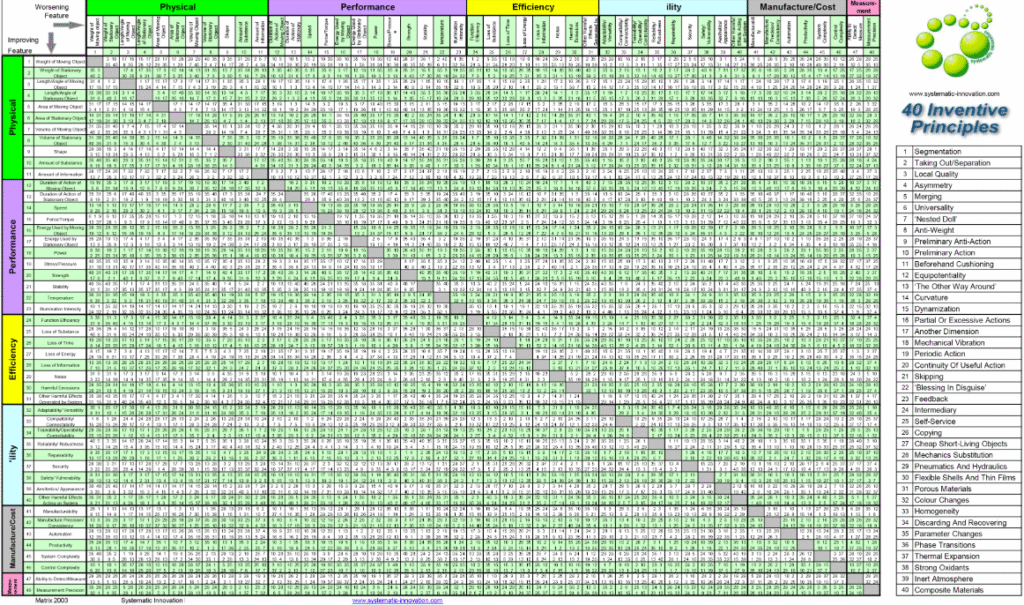
Those principles were all collected from the research Altshuller conducted and represent what was found in the analyzed innovation projects. As you might notice, those principles are more suited to “heavy” engineering, such as factory structures and mechanical engineering. That’s because, of course, those were the topics mostly studied back then. It doesn’t stop managers and leaders from still using it nowadays, or adapting it to different uses, such as marketing or Management.
Now, even when you use TRIZ in its original form, the framework is still very useful because it prompts the user to consider different angles and perspectives, which will almost inevitably lead to insights and, often, the resolution of the problem. That is the main benefit of using an innovation methodology such as TRIZ, or some of its “relatives” like Nine Windows.
Having these tools, frameworks, and methodologies at hand can enable any team or company to break the “lack of creativity” blockage, solve problems, and bring innovative solutions to any market and scenario. Maybe it’s time to structure your organization’s innovation efforts (regardless of whether inside the research & development department or not) and increase your impact in your market -have you ever tried that?
Do you want to learn how to implement innovation processes and help your business in Oxford County, or any other part of Southern Ontario? Talk to us